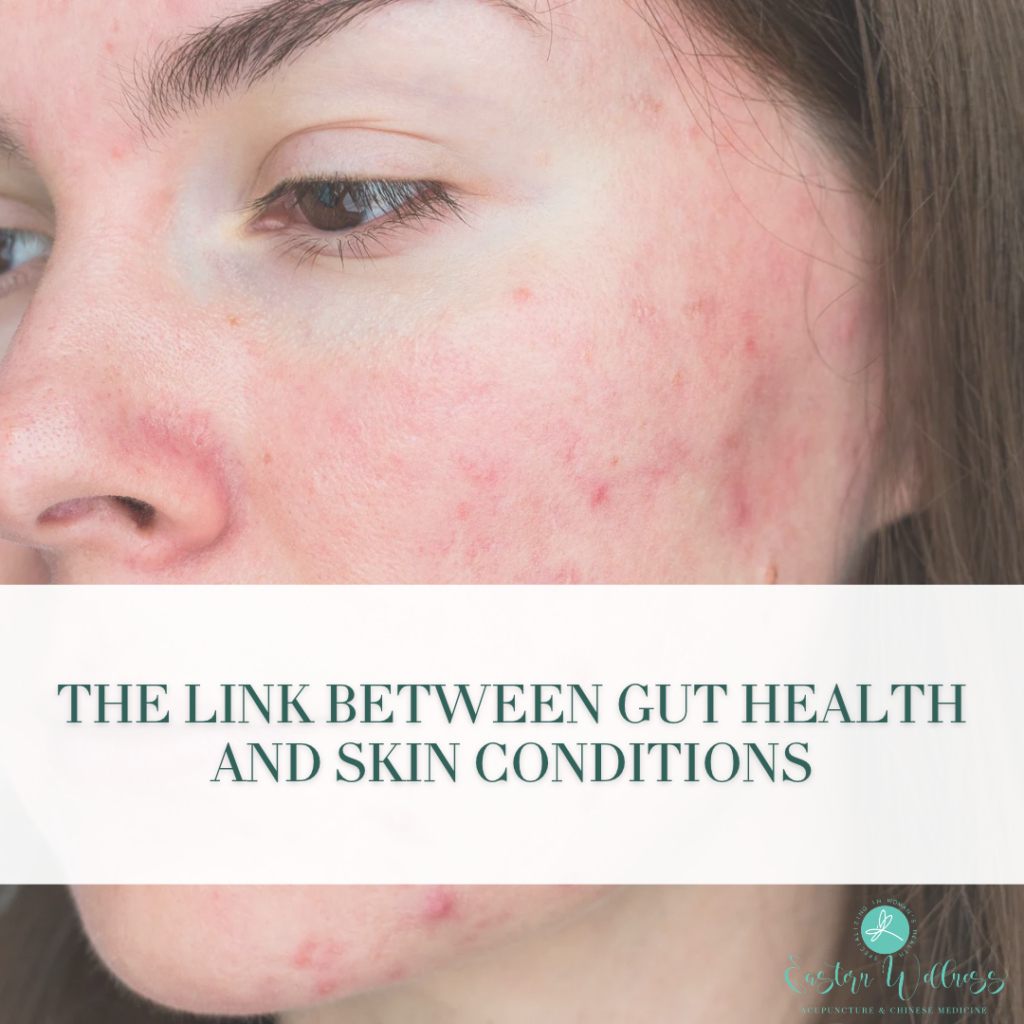
When someone struggles with acne, eczema, rosacea, psoriasis, or another persistent skin concern, the first instinct is usually to focus on the skin.
Change the cleanser.
Try a different moisturizer.
Add another serum.
Avoid certain skincare ingredients.
And sometimes topical treatment is exactly what the skin needs.
But what happens when the problem keeps coming back?
This is where we need to look at a bigger picture.
Your skin does not function separately from the rest of your body. It communicates with your immune system, hormones, nervous system, metabolism, and—perhaps more than many people realize—your digestive system.
Researchers increasingly describe this relationship as the gut-skin axis.
The connection between gut health and skin conditions does not mean every breakout starts in the gut or that every skin condition can be treated by changing your diet.
It means that the health of the gut may influence some of the biological systems involved in skin health, particularly inflammation and immune regulation.
From both Functional Medicine and Traditional Chinese Medicine (TCM), this makes sense.
We don’t want to look only at what is happening on the surface.
We also want to ask:
What is happening underneath it?
Your Skin Is More Than a Surface
We often think about skin cosmetically.
Is it dry?
Oily?
Red?
Clear?
Breaking out?
But your skin is an organ.
It provides a barrier between your internal body and the outside world, and it has its own immune system and microbial ecosystem.
Interestingly, your gut shares some of these characteristics.
Both your intestinal tract and your skin are important barriers. Both interact with microorganisms. Both communicate with your immune system. And both respond to changes occurring in your environment.
A peer-reviewed review published in Frontiers in Microbiology describes the gut-skin axis as a bidirectional relationship in which the gut microbiome may influence skin homeostasis, immune responses, and several inflammatory skin conditions.
You can read the peer-reviewed article here:
That doesn’t mean the gut controls everything happening on your skin.
But it does mean the two systems are not completely separate.
What Exactly Is the Gut-Skin Axis?
You may already be familiar with the gut-brain axis.
The gut-skin axis works on a similar principle.
Your organs do not function independently.
The microorganisms living inside your digestive tract produce metabolites and interact with your intestinal barrier and immune system. Those signals can have effects beyond the digestive tract.
Current research suggests communication along the gut-skin axis may involve:
- Immune signaling
- Inflammatory pathways
- Microbial metabolites
- Hormonal and metabolic pathways
- Nervous system signaling
- Gut and skin barrier function
A review of the gut and skin microbiomes published in Microorganisms discusses associations between microbial changes and conditions including acne, psoriasis, rosacea, and atopic dermatitis.
This helps us understand why gut health and skin conditions have become such an important area of research.
The connection is not simply:
Bad gut = bad skin.
The relationship is much more complicated.
Your Microbiome Is Part of the Conversation
When we talk about gut health, we inevitably have to talk about the microbiome.
Your gastrointestinal tract contains a large community of microorganisms.
Your skin has its own microbiome too.
The goal is not to eliminate bacteria.
We need bacteria.
The goal is a microbial ecosystem that can coexist appropriately with the body.
When that ecosystem becomes disrupted, we often use the word dysbiosis.
Dysbiosis has been studied in connection with several inflammatory skin diseases, but we need to be careful with what that means.
Finding different microbial patterns in people with a skin condition does not automatically tell us whether those microbial changes caused the disease, resulted from the disease, or developed alongside it.
That distinction matters.
For example, research examining psoriasis and atopic dermatitis has found microbiome differences, but researchers have also emphasized that it has not been definitively established whether those changes are a cause or consequence of the conditions.
In other words:
The microbiome matters, but we should not oversimplify it.
Inflammation May Be One of the Connecting Bridges
One of the strongest themes in gut-skin research is inflammation.
Your immune system is constantly interacting with the intestinal environment.
That interaction is necessary.
The goal is not to eliminate inflammation completely. Inflammation is part of normal immune function.
The problem is dysregulation.
Changes in microbial communities and intestinal barrier function may influence immune signaling and inflammatory pathways that extend beyond the gastrointestinal tract.
The skin can participate in those same systemic immune processes.
This gives us one possible explanation for why gut health may be relevant to inflammatory skin conditions.
Again, this does not mean inflammation in the gut automatically causes inflammation on the skin.
It means that when we are looking at a chronic inflammatory condition, it makes sense to consider the entire inflammatory environment rather than assuming the skin exists in isolation.
What About Acne?
Acne is a great example of why we need a whole-body perspective without oversimplifying the condition.
Acne is not caused by one thing.
Its development can involve:
- Sebum production
- Follicular changes
- Inflammation
- Hormonal factors
- Genetics
- Microbial activity
- Metabolic factors
The microbiome is increasingly being investigated as another part of this picture.
A 2022 peer-reviewed review specifically examining acne and the gut-skin axis described acne as a multifactorial inflammatory disease in which both skin and gut microbiota may be involved. The authors also discussed immune signaling as an important potential pathway connecting intestinal microbial activity with skin homeostasis.
This is fascinating, but it does not mean everyone with acne needs a probiotic.
And it certainly doesn’t mean acne proves that your gut is “toxic.”
It means that when acne is persistent, especially when other symptoms are present, we may want to broaden our questions.
How is digestion?
How is bowel regularity?
What does the diet look like?
How is blood sugar regulation?
What is happening hormonally?
How much stress is present?
What medications are being used?
Instead of searching for one universal cause, we look at the pattern.
Acne Is Also About the Skin Microbiome
There is another reason not to reduce acne to gut health alone.
Your skin microbiome itself matters.
A recent systematic review examining acne and the cutaneous microbiome found evidence implicating organisms including Cutibacterium acnes, Staphylococcus aureus, and Staphylococcus epidermidis through complex patterns involving dysbiosis, overgrowth, and interactions among microorganisms.
So once again, the answer isn’t:
“Fix your gut and your acne will disappear.”
The more accurate question is:
“What combination of factors may be contributing to this person’s inflammatory pattern?”
Eczema and the Gut-Skin Connection
Atopic dermatitis, commonly called eczema, is another condition where researchers have become increasingly interested in the gut-skin axis.
Atopic dermatitis involves impaired skin barrier function and immune dysregulation, and microbial changes have been identified in both the skin and gastrointestinal tract.
Research into the gut-skin axis suggests that gut microbial metabolites may interact with immune pathways and potentially influence skin barrier function.
However, this field is still developing.
We should not assume that every case of eczema begins with gut dysbiosis or that changing the microbiome can replace established dermatologic treatment.
Instead, gut health may represent one piece of a larger inflammatory and immune picture.
That is a much more useful way to think about it.
Psoriasis and Systemic Inflammation
Psoriasis makes the whole-body nature of skin health even more obvious.
Although psoriasis appears on the skin, it is an immune-mediated inflammatory disease.
Research has identified changes in both skin and gut microbial communities among people with psoriasis, and researchers continue to investigate whether these changes influence inflammatory signaling or occur as part of the disease process.
Again, association does not automatically mean causation.
But it reminds us of something important:
A symptom can appear on the skin while involving processes happening throughout the body.
This is exactly why Functional Medicine asks us to widen the lens.
Rosacea and the Gut
Rosacea is another interesting example.
Research into rosacea and the microbiome is still developing, but investigators have identified potential relationships involving immune dysregulation, microbial factors, vascular changes, nervous system activity, and the gut-skin axis.
A peer-reviewed review published in Frontiers in Microbiology describes rosacea as an inflammatory condition with immune, vascular, nervous system, and microbial components. The authors note that the gut-skin connection in rosacea has been less extensively studied than in conditions such as psoriasis and atopic dermatitis.
That last part is important.
There is promising research.
But promising does not mean proven.

Does This Mean Probiotics Will Fix Your Skin?
This is where the wellness world often gets ahead of the science.
We learn that the microbiome may influence skin health, so the next conclusion becomes:
“Take probiotics.”
But the microbiome is an ecosystem.
Different probiotic strains do different things.
Different people begin with different microbial communities.
And different skin conditions have different underlying mechanisms.
Recent systematic reviews of microbiome-targeted interventions suggest that probiotics, prebiotics, and related therapies may have potential as adjunctive approaches in some inflammatory skin conditions, but results remain heterogeneous and more research is needed to determine which interventions work best, for whom, and under what circumstances.
So I would not look at probiotics as a universal skin treatment.
We need to understand the person first.
Food Matters—but So Does the Overall Pattern
Naturally, if we are discussing the gut, food becomes part of the conversation.
But I want to be careful here too.
We should not create unnecessary fear around food.
The answer to every skin condition is not:
Stop dairy.
Stop gluten.
Stop sugar.
Stop eggs.
Stop everything.
Sometimes elimination may be appropriate based on an individual’s condition and clinical picture.
But endlessly removing foods without understanding why can leave someone with an increasingly restrictive diet without necessarily addressing the underlying pattern.
Functional Medicine asks us to look more broadly.
What is the quality of the diet?
Is there enough fiber?
Are we eating a diversity of nourishing foods?
How stable is blood sugar?
How is digestion?
Are bowel movements regular?
Are there identifiable triggers?
And how does the individual actually respond?
The goal is not restriction for the sake of restriction.
The goal is to create an internal environment that supports health.
Stress Connects the Gut and Skin Too
Have you ever noticed your skin flare during a stressful period?
Stress does not stay in your mind.
Your nervous system communicates with your digestive system, immune system, endocrine system, and skin.
That means chronic stress may influence the gut-skin relationship from multiple directions.
Maybe stress changes digestion.
Maybe sleep gets worse.
Maybe food choices change.
Maybe inflammatory signaling changes.
Maybe you begin picking at your skin because you’re anxious.
The point is not to blame stress for every breakout.
The point is to recognize that the whole system communicates.
Sometimes the skin is simply where we can see the result.
The TCM Perspective: The Skin Reflects the Internal Pattern
Traditional Chinese Medicine has always looked at the skin as part of a larger internal pattern.
In TCM, we do not simply see:
Acne.
Eczema.
Redness.
Dryness.
Itching.
We ask what pattern is creating the environment in which those symptoms are occurring.
Digestion is an important part of that assessment.
The Spleen and Stomach are responsible for transforming food and nourishment.
When Spleen Qi becomes weak, transformation and transportation may become less efficient.
This may contribute to patterns involving Dampness.
In other people, we may see Heat, Damp-Heat, Blood Heat, deficiency, or stagnation.
The skin manifestation may look similar on the surface, but the underlying TCM pattern may be very different.
That is why we don’t treat everybody the same way.
The Lung and the Skin
TCM also has an important relationship between the Lung and the skin.
The Lung is associated with the exterior of the body and plays a role in the body’s protective functions.
This is another example of how Chinese Medicine does not separate the skin from internal organ systems.
What appears externally can give us information about what may be happening internally.
But we still have to evaluate the complete pattern.
The tongue.
The pulse.
Digestion.
Sleep.
Energy.
Stress.
Menstrual health when relevant.
Temperature.
Bowel movements.
Emotions.
The skin is one part of the story.
Your Skin May Be Giving You Information
I think this is the most helpful way to approach the connection between gut health and skin conditions.
Your skin is not necessarily telling you:
“Your gut is unhealthy.”
It may be telling you:
“Look deeper.”
Maybe the primary issue is dermatologic.
Maybe hormones are playing a significant role.
Maybe the microbiome is involved.
Maybe stress is contributing.
Maybe digestion and inflammation are part of the pattern.
Maybe several things are happening at the same time.
The goal is not to force every symptom into one explanation.
The goal is to understand the relationships.
Don’t Ignore Appropriate Dermatologic Care
A whole-body approach should never mean ignoring the skin itself.
Persistent, severe, painful, rapidly changing, infected, blistering, or unexplained skin symptoms deserve appropriate medical evaluation.
The same is true for changing moles or lesions, significant hair loss, or skin symptoms occurring with other systemic signs.
Supporting gut health can complement appropriate dermatologic care.
It should not automatically replace it.
This distinction matters because Functional Medicine and TCM work best when we use them to expand our understanding of the person—not when we use them to explain away symptoms that require medical attention.
The Bigger Picture
The connection between gut health and skin conditions gives us another example of something I talk about frequently at Eastern Wellness:
The body is interconnected.
Your skin is not functioning in one room while your gut functions in another.
The gut microbiome communicates with the immune system.
The immune system communicates with the skin.
The nervous system communicates with both.
Food, sleep, stress, hormones, digestion, microbial activity, and the environment all become part of a much larger conversation.
Research into the gut-skin axis is giving us new ways to understand these relationships, particularly in inflammatory conditions such as acne, atopic dermatitis, psoriasis, and rosacea.
But we should not take that emerging science and turn it into another oversimplified wellness promise.
Not every skin condition comes from the gut.
Not everyone with acne has dysbiosis.
And taking a probiotic is not a universal treatment for skin disease.
Instead, we can use the gut-skin connection to ask better questions.
What is driving inflammation?
How is digestion functioning?
What is happening with the microbiome?
How is the person sleeping and managing stress?
What patterns do we see throughout the entire body?
In Functional Medicine and Traditional Chinese Medicine, that is where we begin.
We don’t simply chase what we can see on the surface.
We look at the whole pattern underneath it.
Ready to Look Beyond the Surface?
If you’re struggling with persistent acne, eczema, rosacea, psoriasis, digestive symptoms, or skin concerns that continue to return, it may be time to look beyond the skin alone.
At Eastern Wellness, we combine Traditional Chinese Medicine and Functional Medicine to identify the underlying patterns that may be contributing to how you feel. We look at digestion, nutrition, stress, sleep, inflammation, hormonal health, and your individual TCM pattern as part of the larger picture.
The goal isn’t to assume your gut is causing your skin condition.
The goal is to understand how the different systems in your body may be interacting—and where your body may need additional support.
Schedule your consultation today and take the next step toward understanding your body, restoring balance, and supporting healthier skin from the inside out.